

 Live Chat


ADTO News
Seamless vs. Welded Steel Pipes: Technical Comparison & Selection Guide
In industrial fluid transport, power generation, and structural engineering, selecting between seamless pipes and welded pipes directly impacts system safety, operational pressure thresholds, and capital expenditure. While seamless piping provides ultimate wall integrity for extreme thermal and high-pressure environments, welded piping delivers unmatched cost efficiency and large-diameter scalability for major infrastructure networks.
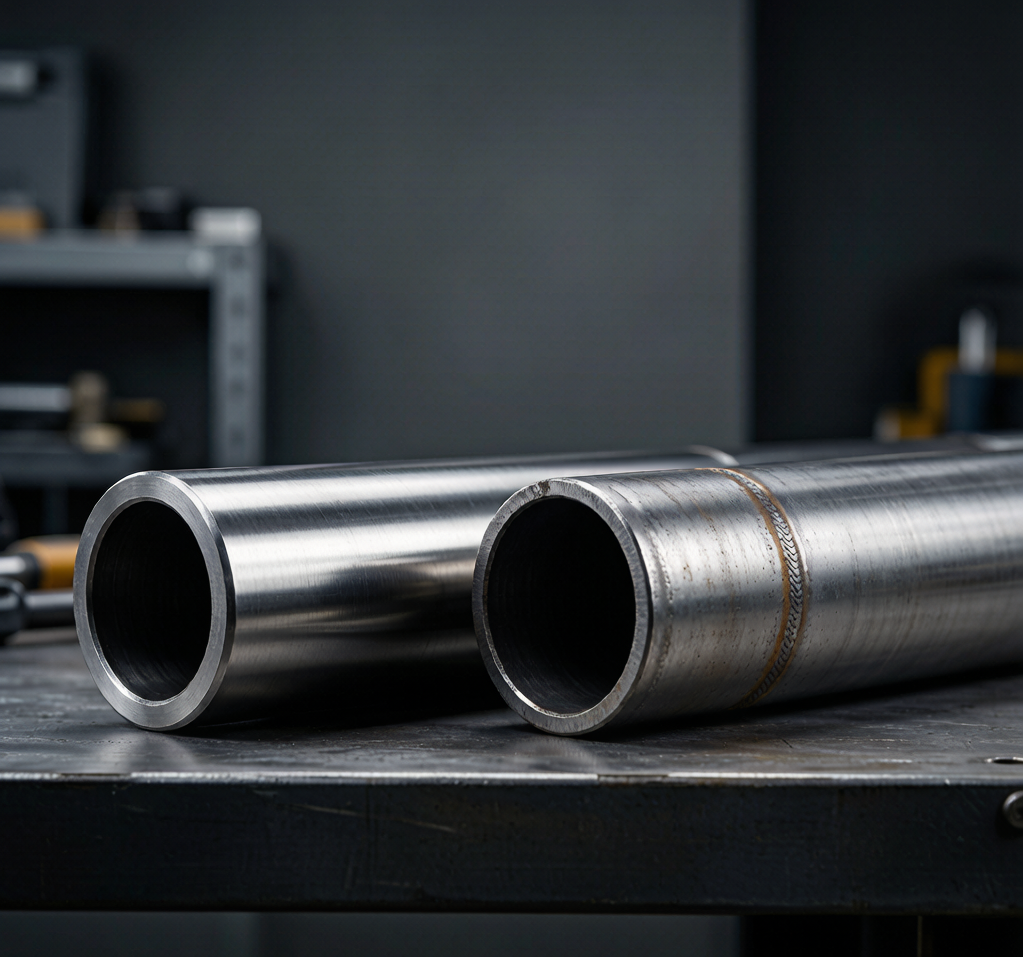
Seamless Steel Pipes: Maximum Integrity for High-Pressure Critical Systems
Manufacturing & Alloy Varieties: Manufactured by hot-extruding solid steel billets over a piercing mandrel, seamless pipes eliminate longitudinal seams entirely. Common specifications include ASTM A106 carbon steel for high-temperature service, ASTM A335 low-alloy steel for power station steam lines, Grade 316L stainless steel for chemical processing, and titanium alloys for subsea aerospace hydraulics.
Unmatched Pressure & Thermal Thresholds: Because seamless pipes feature 100% continuous wall uniformity, ASME B31.3 piping codes assign them a joint efficiency factor of $E = 1.0$ without requiring additional non-destructive testing (NDT). This allows seamless piping to safely handle continuous internal operating pressures exceeding 300 bar (4,300+ psi) and temperatures above 550°C, making them essential for supercritical boiler tubes and subsea oil well risers.
Corrosion Uniformity & Sour Gas Performance: Lacking a weld heat-affected zone (HAZ), seamless pipes eliminate preferential seam corrosion and intergranular cracking under wet hydrogen sulfide ($\text{H}_2\text{S}$) exposure. In offshore oil platform installations, specifying seamless alloy piping extends maintenance-free service life by 20 to 30 years.
Production Limits & Cost Factors: Due to the energy-intensive thermal extrusion process, seamless pipes carry a 20% to 40% cost premium over welded equivalents. Additionally, manufacturing physics limit seamless production primarily to outer diameters (OD) below 24 inches (610 mm).
Welded Steel Pipes: Cost Efficiency & Large-Diameter Scalability
Diverse Fabrication Technologies: Welded pipes are produced by cold-forming steel plate or coil into cylindrical shapes and joining the seams via automated welding. Key types include Electric Resistance Welded (ERW) for low-to-medium pressure utilities, Longitudinal Submerged Arc Welded (LSAW) for heavy-wall energy transmission, and Spiral Submerged Arc Welded (SSAW) for massive municipal water pipelines.
Large-Diameter Structural Scalability: Unlike seamless pipes, LSAW and SSAW manufacturing methods scale easily to outer diameters ranging from 24 inches to over 100 inches (610 mm to 2,540+ mm). Major cross-country natural gas trunklines—such as API 5L X70 and X80 pipeline projects—rely almost exclusively on large-diameter LSAW pipe to move billions of cubic feet of gas daily across continents.
Economic Advantage & Tight Tolerances: Welded manufacturing offers precise wall-thickness consistency, high production speeds, and lower raw material costs, yielding total project capital savings of 25% to 35% on mid-to-low-pressure distribution grids.
Weld Seam Considerations & Inspection: The longitudinal or spiral seam creates a heat-affected zone that can be vulnerable to stress corrosion or fatigue if untreated. Modern pipe mills perform 100% inline ultrasonic and radiographic NDT inspection alongside post-weld heat treatment (PWHT) to ensure seam joint strength matches the parent plate.
Engineered Selection: Choosing the Right Piping Solution
Specify Seamless Pipes For: High-pressure hydro-processing units, nuclear cooling systems, offshore choke manifolds, and chemical feed lines operating above 200 bar where zero-risk fluid containment and extreme thermal stability are required.
Specify Welded Pipes For: Cross-country oil and gas transmission (LSAW), municipal water distribution mains (SSAW), structural building pilings, and standard HVAC utility loops (ERW) where large pipe diameters and project budget optimization are driving priorities.
Selecting between seamless and welded piping requires balancing design pressure, material codes, and overall project economics. Contact our technical engineering specialists today to request material test reports (MTRs), pressure-rating calculations, and competitive factory-direct pricing for your upcoming project.